
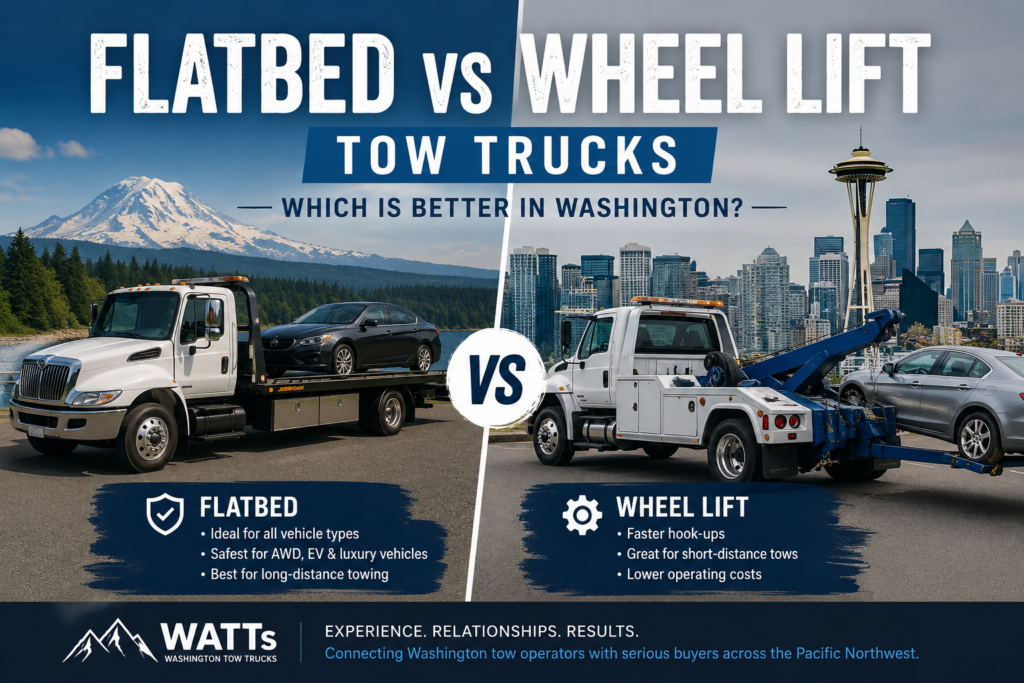
As the owner of WATTs, I work with tow truck operators across the Pacific Northwest who want to sell or consign their trucks, everything from duty wreckers to side recovery units. I speak with them daily about the type of truck they run and why they prefer it for our roads, seasonal conditions, and regional towing needs.
There’s one question I always hear: Should I stay with a flatbed or invest in a wheel list?
If you’re in the same boat, this article will help you understand how each truck performs and what other operators in the region think about each class.
When Does a Faltbed Make Sense?
Flatbeds make sense when you need to transport vehicles with all four wheels off the ground, or make long-distance tows on I-90, I-5, and the rural highways that cross the Cascades. They’re durable, reliable, and strong enough to endure our roads.
Flatbed carriers handle:
- AWD vehicles
- EVs
- Light commercial vehicles
- Collision recoveries
- Low-clearance vehicles
Because of their versatility, they’re also a strong choice if you work on claims, accident scenes, or dealership transport.
In Washington, a lot of buyers in the private towing sector look for flatbeds specifically because of insurance contracts and municipal agreements requiring transport methods to protect the vehicle during recovery.
Under RCW 46.37.450, for example, the state places legal expectations on operators responding to disabled or stranded vehicles.
Plus, many EV and AWD manufacturers literally instruct owners not to tow their vehicles using a wheel lift.
When Does a Wheel Lift Make Sense?
A wheel lift makes sense when you need to maneuver into spaces where flatbeds can’t get to. Think Seattle, Tacoma, and Bellevue, cities with tight alleys, steep parking structures, and parallel parking rows.
They’re ideal for handling:
- Tight urban recoveries
- Quick service rotations
- Private property impounds (where permitted by local code)
- Light-duty roadside calls
If you do volume work in urban centers, or if your primary calls include roadside assistance, jump starts, lockouts, and short tows, a wheel lift might meet all your needs.
They can extract a vehicle from these areas quickly and efficiently, offering a fast hookup time for short-distance towing.
What Factors Should You Consider Before Choosing Between a Flatbed and Wheel Lift?
Of course, there are several additional factors to consider before choosing between a flatbed and a wheel lift, like Washington weather and regional road conditions.
Let’s dig a little deeper.
How Washington Roads Affect the Type of Tow Truck You Need
Where you work across Washington can impact the right type of truck for your needs. Operators in Seattle face different work than those in Spokane or the Peninsula.
If you take a lot of calls in cities or urban areas, a wheel lift is a logical choice. It’ll be easier to handle and operate in dense urban zones.
But the steep grades across Snoqualmie Pass and Stevens Pass require strong braking, proper wheelbase, and stable load control.
Wheel lifts can make the climbs, but weight distribution matters when pulling a vehicle with two wheels on the ground.
In these mountain corridors, it’s beneficial to have the low center of gravity offered by Flatbeds.
How Washington Weather Influences Flatbed and Wheel Lift Performance
Washington weather also pushes trucks hard, so take it into consideration when choosing between a flatbed or a wheel lift.
You’ve got to ask yourself, are you mostly taking long calls or short transport in a city?
Seasonal conditions in Washington can bring ice and low visibility, especially in the East. Think about how much mileage you’re going to put on your truck, including during sub-optimal driving conditions.
Flatbeds are ideal for loading disabled vehicles and securing them against sliding during transport. Wheel lifts, on the other hand, can struggle if the disabled vehicle has damaged tires or wheels.
How Operational Costs Differ Between Flatbeds and Wheel Lift Tow Trucks
Wheel lifts and flatbeds also have different operational costs, so keep this in mind when making your choice.
Wheel lifts are known for having lower upfront costs and lower maintenance overall than flatbeds.
This is because flatbeds have more hydraulic components and a larger deck system.
Flatbeds can offer you the widest range of calls and higher revenue per tow, but wheel lifts give you more control over long-term operating expenses, especially because they’re so straightforward to service.
Which One Is Best for You?
At the end of the day, there’s no single answer to this question. Flatbeds are the prefferde choice for towing EVs and AWD vehicles, for accident recoveries, and for long-distance corridor transport.
Wheel lifts excel in compact cities and urban areas, where fast rotation is required.
Many successful operators in the state run mixed fleets for this reason, because it enables them to handle and respond to the full range of calls.
How Your Tow Truck’s Value is Established Through Watts
Got a truck you’re ready to consign? I can help with that.
When you submit your truck to WATTs, you send the VIN, the body serial number, and full walkaround photos of your vehicle. This helps me understand how your truck has been used and how the buyer will view it.
I look at everything: the cab condition, the deck rails, the subframe, the boom, the hydraulic lines, the wheel lift stinger, the winch housing, and more.
Because market trends shift throughout the year, I constantly check current regional sales data before calling with a realistic consignment value.
After I complete the valuation and speak with you, your unit is listed through Fleet Sales West in Woodburn, Oregon, one of the most trusted heavy truck dealers in the region.
They’ll give your truck the visibility it needs, and every lead that comes through will be routed through our WATTs DP360 CRM so you can see the activity in real time.
Once the right operator finds your truck, I help facilitate the transaction from handshake to title transfer, keeping the process efficient and clear so you can stay informed and comfortable at every step.
With WATTs, There Are No Surprises or Dead Ends, Just Deals
If you want to consign your flatbed, wheel lift, carrier, lowboy, or recovery unit, I can help you reach qualified buyers across the Pacific Northwest.
Submit your truck through Washington Tow Trucks today; I’m ready to get your valuation started!